
Lowsley, B. 1888. A Glossary of Berkshire Words and Phrases English Dialect Society, London, Trubner, 1888, pp.17-22
Piggott, S. 1929. ‘Collectanea. Mummers' Plays from Berkshire, Derbyshire, Cumberland, and Isle of Man’ Folk-Lore, 40-3, 262-44


 There was recently an article in the Daily Fail about an archive of sound recordings held in the British Library made by German researchers of British POWs whilst they were in captivity in prisoner of war camps.

 I caught In Our Time yesterday with Dan Hicks and Richard Bradley talking about Victorian archaeologist, anthropologist and collector Augustus Pitt-Rivers which reminded me of the recent publication of a volume on the world archaeology collections in the Pitt-Rivers Museum in Oxford. Whilst focussing primarily on the overseas ethnographic collections, it also reviews the local collections. I was intrigued how relatively little from the region ended up in the museum, with the Vale being represented only by a few minor objects from Uffington and Sparsholt. I suspect though that the majority of archaeological material from Oxfordshire ended up in the Ashmolean- I’m not entirely clear how far the collections policy of the two institutions were harmonised, particularly in the later 19th and earlier 20th centuries. One of the things I need to do at some point is explore the Pitt-Rivers Museums excellent "The Other Within" proejct which reviewed their English ethnographic (as opposed to archaeological) holdings, with a view to getting my head round the material from the Vale.
However, it got me thinking more widely about the history of collecting ethnographic material from the Vale. There are obviously a number of museums in the Vale, such as the Vale and Downland Museum in Wantage, the Champs Chapel Museum at East Hendred and the Tom Brown School House museum in Uffington- though I know very little about their history and the development of their collections. One collection that I do know more about is the Lavinia Smith collection which is now in the wonderful Museum of English Rural Life in Reading. Lavinia Smith was American by birth but spent much of the first half of the 20th century living in East Hendred where she built up a collection of over 400 items connected to rural life in the village. There is a nice blog posting from MERL about it here.
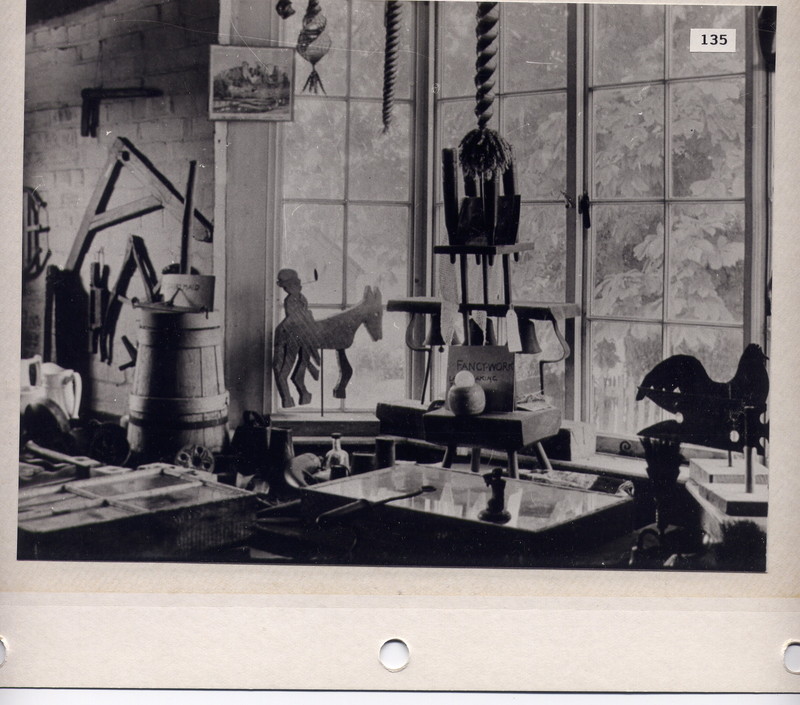
The picture is from the Lavinia Smith collection of images still held in East Hendred - reminds me of the shop window at the beginning of Bagpuss.
I caught In Our Time yesterday with Dan Hicks and Richard Bradley talking about Victorian archaeologist, anthropologist and collector Augustus Pitt-Rivers which reminded me of the recent publication of a volume on the world archaeology collections in the Pitt-Rivers Museum in Oxford. Whilst focussing primarily on the overseas ethnographic collections, it also reviews the local collections. I was intrigued how relatively little from the region ended up in the museum, with the Vale being represented only by a few minor objects from Uffington and Sparsholt. I suspect though that the majority of archaeological material from Oxfordshire ended up in the Ashmolean- I’m not entirely clear how far the collections policy of the two institutions were harmonised, particularly in the later 19th and earlier 20th centuries. One of the things I need to do at some point is explore the Pitt-Rivers Museums excellent "The Other Within" proejct which reviewed their English ethnographic (as opposed to archaeological) holdings, with a view to getting my head round the material from the Vale.
However, it got me thinking more widely about the history of collecting ethnographic material from the Vale. There are obviously a number of museums in the Vale, such as the Vale and Downland Museum in Wantage, the Champs Chapel Museum at East Hendred and the Tom Brown School House museum in Uffington- though I know very little about their history and the development of their collections. One collection that I do know more about is the Lavinia Smith collection which is now in the wonderful Museum of English Rural Life in Reading. Lavinia Smith was American by birth but spent much of the first half of the 20th century living in East Hendred where she built up a collection of over 400 items connected to rural life in the village. There is a nice blog posting from MERL about it here.
The picture is from the Lavinia Smith collection of images still held in East Hendred - reminds me of the shop window at the beginning of Bagpuss.
 Today's episode of Time Team follows on really nicely from my last post. The site they explored is only about 3km due north of the Didcot Great Western site I mentioned in my previous posting. However, the Time Team site is located down on the sands and gravels of the Thames terraces just to the south of Abingdon. In this case there are fantastic cropmarks of the site itself and its immediate hinterland. This image shows the site in its context- it's easy to pick out the RB cropmarks shown on TT as well as prehistoric and AS features to the south-east; the whole area is also braided with palaeochannels.
I do like TT but it is not always very good on context- I *think* they were saying that the site was not near (m)any other villas, which is odd as it's just down the road from Barton Court Farm- also close to a decent town at Dorchester-on-Thames and only about 3 1/2 miles from the big complex at Marcham/Frilford. They also got a bit bogged down in the whole "what is a villa?" debate- making a good stab of exploring the complexities and then getting a bit caught up in a discussion about whether it was a high-status residence OR a centre for agrarian production. Louise Revell commented in passing that the villas were the homes of the members of the urban council (curia) - is that really what we think? I know it's likely that some owners were members of the curia, but surely not all. To be fair to her, the way this kind of tv interview gets edited, the original message doesn't always come out clearly.
The other issue that came to mind watching this was a reminder of how incredibly dense the known RB landscapes (or indeed the landscapes of any early period) are in this part of the Middle/Upper Thames valley. I've always rather taken it for granted having grown up relatively locally- but the more time I spend away the more I realise how unusual the surviving resource is; probably more prehistoric/RB/AS sites in a 10km x 10km block centred on Sutton Courtenay than in all of County Durham...
NB; just noticed that for some reason the North Star in Steventon was thanked in the credits - despite there being no obvious on-screen carousing!
Today's episode of Time Team follows on really nicely from my last post. The site they explored is only about 3km due north of the Didcot Great Western site I mentioned in my previous posting. However, the Time Team site is located down on the sands and gravels of the Thames terraces just to the south of Abingdon. In this case there are fantastic cropmarks of the site itself and its immediate hinterland. This image shows the site in its context- it's easy to pick out the RB cropmarks shown on TT as well as prehistoric and AS features to the south-east; the whole area is also braided with palaeochannels.
I do like TT but it is not always very good on context- I *think* they were saying that the site was not near (m)any other villas, which is odd as it's just down the road from Barton Court Farm- also close to a decent town at Dorchester-on-Thames and only about 3 1/2 miles from the big complex at Marcham/Frilford. They also got a bit bogged down in the whole "what is a villa?" debate- making a good stab of exploring the complexities and then getting a bit caught up in a discussion about whether it was a high-status residence OR a centre for agrarian production. Louise Revell commented in passing that the villas were the homes of the members of the urban council (curia) - is that really what we think? I know it's likely that some owners were members of the curia, but surely not all. To be fair to her, the way this kind of tv interview gets edited, the original message doesn't always come out clearly.
The other issue that came to mind watching this was a reminder of how incredibly dense the known RB landscapes (or indeed the landscapes of any early period) are in this part of the Middle/Upper Thames valley. I've always rather taken it for granted having grown up relatively locally- but the more time I spend away the more I realise how unusual the surviving resource is; probably more prehistoric/RB/AS sites in a 10km x 10km block centred on Sutton Courtenay than in all of County Durham...
NB; just noticed that for some reason the North Star in Steventon was thanked in the credits - despite there being no obvious on-screen carousing!
 Some nice news reports (here and here) of the extensive range of archaeologiacl features found at Didcot by OA as part of development-control work. There is an interesting range of prehistoric and IA/RB material as well as a little AS evidence. The site seems to lie on the slightly elevated Gault and greensand that skirt the southern edge of the Vale, and is, I think, one of the first extensive open-plan interventions on that kind of landscape. As such, it compliments rather nicely the far more extensively recorded prehistoric, IA/RB, AS landscapes that survive (primarily as cropmarks) on the gravels of the Thames around Abingdon and Dorchester.

